

A strong choice depends on more than a high rating or a convenient location: you need evidence that the dentist can diagnose your problem, explain reasonable options, and provide safe follow-up. Use the checklist below to compare records, clinical scope, consultation quality, safety practices, total cost, and practical support before you book treatment.
Key takeaways
- Verify the dentist’s registration number with your state dental council or National Dental Commission records.
- Ask what the examination found, which treatments are urgent, and which alternatives exist.
- Compare written treatment plans, safety procedures, follow-up access, and total travel time.
- Request itemised costs and clarify what happens if treatment needs adjustment or review.
How can you verify a dentist’s credentials and clinical scope?
Do not treat “best dentist” as a credential. Start with dentist registration verification: search the dentist’s registration number and status in your state dental council’s register or National Dental Commission records.
Match the displayed name and qualification with the dental degree recorded by the clinic or shown on official documents, then ask where specialist training was completed.
General dentistry versus specialist care matters when the treatment is complex. Ask whether the clinician has relevant experience in orthodontics, pediatric dentistry, periodontics, endodontics, oral and maxillofacial surgery, implant care, prosthodontics, or complex restorative treatment. A general dentist may coordinate care without personally performing every procedure.
Before agreeing to treatment, ask these questions:
- Will you perform the procedure, coordinate it with a named specialist, or refer me elsewhere?
- For implants or major restoration, how will you assess gum inflammation, bleeding, pocket depth, bone, bite forces, smoking, diabetes control, medications, and my ability to maintain the result?
- Which records, specialist reports, and follow-up visits will I receive?
- Who handles complications, urgent pain, swelling, or after-hours problems?
Choose another clinic if it cannot provide the required procedure, a named specialist referral, complete records, appropriate sedation, or emergency support. A clinic offering many services under one roof is not proof that one dentist has the training or experience for every case.
What should happen during a trustworthy first consultation?
A trustworthy first dental consultation produces a diagnosis before it produces a sales pitch. The dentist should record medications, allergies, pregnancy status, tobacco use, previous anesthesia complications, diabetes, heart disease, and blood-thinning therapy because these can change treatment safety and timing.
Ask these questions before agreeing to care:
- What is the dental diagnosis, and which tooth or tissue is affected?
- What alternatives exist, including monitoring or conventional treatment?
- What result, risks, number of visits, recovery time, and maintenance will I face?
- What happens if I delay treatment?
The examination should determine which records are useful rather than generate automatic tests.
| Record | What it should clarify | When it may be appropriate |
|---|---|---|
| Dental X-rays | Decay, roots, bone, infection, or hidden structures | Based on age, symptoms, findings, caries risk, and previous images |
| Intraoral photographs | Visible cracks, wear, gum changes, and treatment progress | When documentation or comparison will help |
| Periodontal measurements | Bleeding, pocket depth, recession, mobility, and gum support | When gum disease or bone loss is suspected |
Expect a written treatment plan naming the diagnosis, proposed procedure, alternatives, risks, visits, and follow-up. Cosmetic care should not come first: whitening, veneers, crowns, or bonding can hide untreated decay, infection, gum disease, or bite problems.
If the dentist proposes implants or laser treatment, ask for the diagnosis, conventional alternative, and whether the technique changes prognosis, cost, or follow-up. A laser is a tool, not proof of better care.
How do you compare two dentists when their recommendations differ?
Start by requesting both diagnoses in writing before you compare dental treatment plans. Each document should identify the tooth or area, clinical findings, radiographs or photographs used, treatment objective, alternatives, and risks of waiting. A second dental opinion is most useful when both dentists are responding to the same records.
Ask these questions:
- What finding makes treatment urgent, and what could safely be monitored?
- Is the disagreement about diagnosis or treatment preference?
- Do you need new images, or are existing records adequate? Insist on risk-based dental X-rays selected by age, symptoms, examination, caries risk, and previous radiographs—not automatic repeat exposure.
- What fluoride plan fits your decay risk, diet, age, and current products?
- For a child, has orthodontic screening occurred by age seven? Screening does not mean immediate braces.
- For an implant, were gum health, bone, bite forces, smoking, diabetes control, medications, and long-term cleaning assessed?
| Option | Key trade-offs to compare |
|---|---|
| Monitoring versus filling | Lesion depth, progression risk, hygiene, and the consequence of waiting |
| Root canal versus extraction | Saving the tooth, infection control, visits, restoration, cost, and replacement needs |
| Composite versus amalgam fillings | Cavity size, moisture control, chewing forces, durability, appearance, cost, and medical circumstances; ask about amalgam precautions for pregnancy, children, or certain neurologic or kidney conditions |
| Implant versus another replacement | Bone and periodontal suitability, maintenance demands, staged treatment, and alternatives such as a bridge or denture |
A confident recommendation explains why one option fits your findings, not merely which procedure the dentist prefers.
Which safety and comfort standards should you compare between clinics?
A clinic’s dental infection control should be visible: staff perform hand hygiene, wear fresh gloves and masks, disinfect chair and contact surfaces between patients, and place used needles in puncture-resistant sharps containers. Ask whether reusable instruments undergo heat-based instrument sterilisation and whether sealed packs are opened at chairside.
| Option | What to compare | Key safety question |
|---|---|---|
| Local anaesthetic | Numbs the treatment area while you remain awake | What drug, dose, allergy precautions, and pain-control plan apply? |
| Deeper sedation | Reduces awareness and can impair breathing or protective reflexes | Who administers and monitors it, and what airway-rescue equipment is available? |
| Anxiety support | Explanations, stop signals, shorter visits, or behavioural techniques | How will the team adapt care without unnecessary sedation? |
Sedation safety includes documented monitoring, recovery observation, and clear transport instructions; deeper sedation needs stronger airway and rescue capability than local anaesthetic alone.
Compare these practical points before booking:
- Ask for the dental emergency policy, including after-hours contact and the response to facial swelling, fever, swallowing or breathing difficulty, dehydration, or rapidly worsening pain. These symptoms need urgent assessment, not a routine filling appointment.
- Check expected appointment delays, communication methods, wheelchair or sensory accessibility, continuity if the treating dentist is unavailable, and who handles follow-up.
- Tell the dentist about pregnancy, diabetes, heart disease, anticoagulant use, disability, age-related risks, or a child’s needs. The plan should also address dental anxiety and medication or monitoring changes.
A clinic that cannot explain its procedures, sedation plan, emergency response, or adaptations gives you little basis for a safe comparison.
How do cost, follow-up, and travel affect the right choice?
A low quoted fee is not the treatment cost. Compare the full burden, including visits, recovery time, travel, maintenance, and the risk of paying again for omitted steps.
A written dental treatment estimate should name each procedure, tooth or site, materials, diagnostic records, anesthesia or sedation, laboratory charges, medicines, specialist fees, review visits, maintenance, and possible additional treatment. Ask whether insurance and payment plans influence the recommendation, and request alternatives with their clinical trade-offs, not only their prices.
| Compare | Local clinic | Distant clinic |
|---|---|---|
| Visits | Easier to attend reviews | Travel adds time to each visit |
| Access | Parking and urgent access may be simpler | Longer journeys complicate emergencies |
| Recovery | Easier to arrange transport and rest | Returning home after treatment may be difficult |
| Maintenance | Practical for periodontal, orthodontic, denture, or implant care | Ongoing appointments demand more planning |
Count dental follow-up visits and ask when each occurs, not just how many appointments treatment needs. A clinic offering broad services can help when it coordinates records and referrals, but confirm whether the procedure is appropriate, who will perform it, and how follow-up is managed.
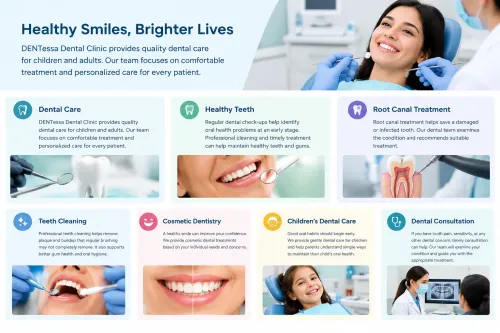
DENTessa Dental Clinic Pimple Saudagar,PCMC may be worth comparing when local coordination, preventive assessment, and continuing reviews matter, provided it answers the same checklist clearly. A convenient clinic is the wrong choice if convenience hides unclear treatment responsibility or incomplete maintenance planning.
Related service
Dentist in Pimple Saudagar Dentist in Pimple Saudagar, Pimple Gurav, PCMC ₹350 Dr Ketaki Jadav is the Best Dentist in Pimple Saudagar, Rahatani, Pimple Nilakh, Kalewadi and Pimpri Chinchwad. View service → |
Frequently asked questions
How can you verify a dentist’s credentials and clinical scope?
Search the dentist’s registration number and status in your state dental council’s register or National Dental Commission records. Then ask which procedures the dentist personally performs and which require referral to another clinician.
What should happen during a trustworthy first consultation?
The dentist should review your concerns and medical history, examine your teeth and gums, explain the findings in plain language, and identify urgent versus optional care. Ask for treatment alternatives, expected visits, risks, and follow-up arrangements.
How do you compare two dentists when their recommendations differ?
Request written diagnoses and treatment plans from both dentists. Compare the findings, proposed sequence, alternatives, risks, number of visits, and reasons for choosing fillings, root canal treatment, extraction, implants, orthodontics, or observation.
Which safety and comfort standards should you compare between clinics?
Ask how instruments are cleaned and sterilised, how treatment areas are disinfected, how medical histories and X-rays are stored, and what emergency procedures are available. Also compare pain-control options, appointment communication, and accessibility.
How do cost, follow-up, and travel affect the right choice?
Compare itemised fees, included visits, diagnostic charges, payment stages, and possible additional treatment. Check who handles complications, how quickly follow-up appointments are available, and whether travel time makes completing the full treatment practical.