

Severe tooth pain does not always mean you need a root canal, and a pain-free tooth is not necessarily healthy. You will be able to judge how urgently to seek care, understand which tests guide treatment, and compare treatment choices before you book an appointment.
Key takeaways
- Seek emergency care for breathing difficulty, swallowing problems, or spreading facial swelling.
- Fever, severe pain, and gum swelling can signal an abscess needing prompt treatment.
- A dentist uses symptoms, X-rays, and tooth tests to choose treatment.
- Compare laser-assisted care by asking about its role, evidence, comfort, and total treatment plan.
Which toothache symptoms need same-day care?
Difficulty breathing or swallowing requires emergency assessment, not a routine root canal appointment. Facial or neck swelling, swelling near the eye, fever, marked weakness, or inability to open your mouth normally can indicate infection spreading beyond the tooth.
| Symptoms | Recommended action | Why it matters |
|---|---|---|
| Trouble breathing or swallowing, facial or neck swelling, swelling near the eye, or severe difficulty opening the mouth | Emergency assessment now | Swelling can threaten the airway or spread into surrounding tissues |
| Facial swelling, fever, gum swelling and pus, worsening taste of pus or bad taste in mouth, or swollen neck glands | Same-day dental visit | An abscess needs treatment to drain or remove its source |
| Severe toothache, spontaneous throbbing, pain that lingers after hot or cold, or pain that disrupts sleep without emergency signs | Appointment within 24 to 48 hours | The pulp may be irreversibly inflamed or dying |
| Brief cold sensitivity that stops quickly and no swelling or worsening symptoms | Routine dental appointment | Early decay still needs assessment before it reaches the pulp |
A sudden drop in pain is not proof of healing. The pulp may have died while infection remains around the root, and a tooth with dead pulp can later form an abscess without hurting.
Pain medicine can help while you wait, but it does not remove infected pulp; antibiotics alone do not fix the tooth and are reserved mainly for spreading infection or systemic symptoms.
When does deep decay become pulp damage or an abscess?
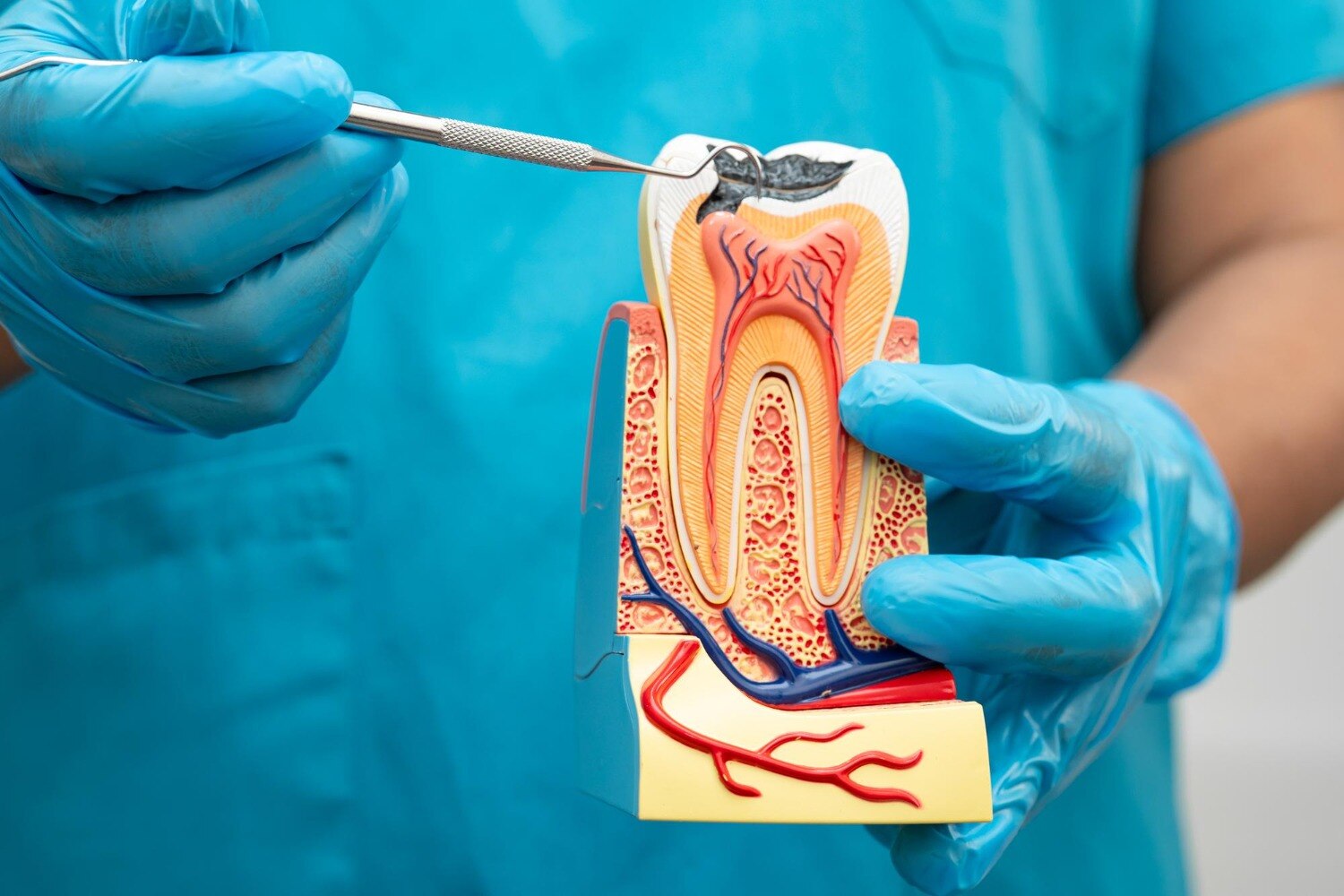
Decay starts in enamel and advances into dentin, the softer layer beneath it. Once bacteria reach the pulp—the chamber containing nerves and blood vessels—deep decay can inflame the tissue, destroy its blood supply, and allow infection to extend through the root into surrounding bone. That later infection can form a dental abscess.
| Pulp condition | Typical pattern | What it indicates |
|---|---|---|
| Reversible pulpitis | Brief sensitivity to cold or sweet foods that stops soon after the trigger is removed | The pulp is irritated but may recover after decay is removed and the tooth is sealed |
| Irreversible pulpitis | Pain that lingers after hot or cold exposure, starts without a trigger, or becomes severe and throbbing | The pulp is unlikely to recover; root-canal treatment or extraction may be needed |
Pain intensity does not identify the stage. A mildly painful tooth can have advanced disease, while a severely painful tooth can suddenly feel better after the pulp dies. That relief is not healing; bacteria can remain inside the tooth and later cause an abscess.
A normal X-ray does not rule out irreversible pulpitis because early pulp damage may not yet change bone or other hard tissue. A dentist must compare your symptoms with tests on the suspected tooth and nearby teeth. Arrange evaluation even if the pain disappears, especially after deep decay or a severe episode.
Antibiotics alone do not remove infected pulp or seal the tooth.
How does a dentist decide between a filling, root canal, extraction, or monitoring?
A dentist chooses a filling, root canal, extraction, or monitoring by combining your symptoms, examination findings, and imaging. No single test proves the diagnosis: a severe toothache can come from pulp inflammation, a crack, a loose restoration, or inflammation around the root.
1. The dentist records pain triggers, duration, spontaneous pain, and pain on biting. A cold pulp test and electric pulp test assess whether the pulp responds; a lingering or abnormal response can support pulp damage, but results must be interpreted with the other findings.
2. Percussion and palpation check for tenderness around the tooth and root. Periodontal probing and bite testing can reveal a deep isolated pocket, a cracked cusp, or pain on biting that a loose or high filling causes.
3. Dental radiographs show decay depth, bone changes, root shape, and previous treatment. Magnification, transillumination, and additional imaging can help locate cracks that a routine X-ray misses.
4. A filling or monitoring fits a tooth with healthy or recoverable pulp, enough remaining tooth structure, and no progressive disease. Root canal treatment fits a restorable tooth with irreversible pulp damage or infection; the tooth then needs a durable final restoration, often a crown for a heavily damaged back tooth.
5. Extraction becomes more predictable when decay leaves too little structure, gum support is inadequate, isolation is impossible, or a vertical root fracture is present. Discuss replacement choices after removal.
What should you do before and during a root canal appointment?
Tell the dentist about pain on biting, pain when lying down, night-time tooth pain, or referred pain to your jaw or ear. Bring your medication list and report allergies, pregnancy, ulcers, kidney or liver disease, blood thinners, and previous reactions to anaesthetic. Eat normally unless sedation instructions say otherwise.
For temporary relief, follow the label or your dentist’s advice for ibuprofen or acetaminophen. Do not exceed the stated dose, combine products containing the same ingredient, or use ibuprofen with a condition or medicine that makes it unsafe. Do not place aspirin on the tooth.
Antibiotics alone do not remove infected pulp or seal the canal; dentists reserve them mainly for spreading infection or systemic symptoms.
- The dentist confirms the tooth with examination, bite testing, pulp tests and radiographs, then numbs it and places a rubber dam.
- A small opening gives access to the pulp. The dentist removes inflamed or dead tissue, cleans and shapes each canal, disinfects it, and fills and seals it.
- One visit may be enough, but complex anatomy, drainage, persistent infection or medication inside the tooth can require multiple visits.
- Protect a temporary filling: chew on the opposite side, avoid sticky foods, and call if it breaks or the tooth feels open.
- Mild soreness after treatment is common; use the advised pain relief and contact the dentist if swelling or severe pain develops.
Arrange the permanent filling promptly. A heavily damaged back tooth often needs a crown; delaying final restoration leaves the tooth vulnerable to leakage and fracture.
How should you compare conventional and laser-assisted root canal treatment?
Choose the clinician and treatment protocol, not the word “laser.” Conventional root canal treatment and laser-assisted endodontic therapy both aim to remove infected pulp, clean and shape every canal, fill and seal the canal system, and restore the tooth.
| Option | What it includes | Evidence and limitation |
|---|---|---|
| Conventional root canal treatment | Rubber dam isolation, hand or rotary instruments, disinfecting irrigants, canal filling and sealing | A proven approach, but success depends on finding and cleaning the complete canal anatomy |
| Laser-assisted endodontic therapy | Standard cleaning and sealing plus laser energy used as an adjunct for disinfection or activation of irrigants | Research supports possible antimicrobial benefits, but it does not prove that lasers replace instruments or guarantee better long-term results |
A laser cannot compensate for a canal calcification or missed canal, inadequate rubber dam isolation, a crack, or a tooth that cannot be restored. Ask whether the laser is an added step or being presented as a replacement for filing, irrigation, and obturation.
Before choosing a clinic, ask:
- Who will perform the treatment, and how will they locate curved, narrow, or extra canals?
- Will you use rubber dam isolation throughout the procedure?
- What exactly does the laser add, and what evidence supports its use for my tooth?
- How will you check the final filling, and what permanent restoration will follow?
- What happens if the tooth has a vertical fracture or cannot be predictably restored?
DENTessa Dental Clinic Pimple Saudagar,PCMC can be compared with other clinics using these same questions, rather than relying on a “laser” label.
Related services
Root Canal Treatment Clinic in Pimple Saudagar Root Canal Treatment Clinic in Pimple Saudagar,PCMC DENTessa Dental Clinic is the Best Root Canal Treatment Clinic in Pimple Saudagar, Rahatani, Pimple Nilakh, Kalewadi and Pimpri Chinchwad. View service → |
Laser Root Canal Clinic in Pimple Saudagar Laser Root Canal Clinic in Pimple Saudagar, Pimple Gurav, PCMC DENTessa Dental Clinic is the Best Laser Root Canal Clinic in Pimple Saudagar, Rahatani, Pimple Nilakh, Kalewadi and Pimpri Chinchwad. View service → |
Frequently asked questions
Which toothache symptoms need same-day care?
Seek same-day dental care for severe or persistent pain, facial swelling, fever, pus, a knocked-out tooth, or difficulty opening your mouth. Difficulty breathing or swallowing, neck swelling, swelling near the eye, or marked weakness requires emergency assessment rather than a routine appointment.
When does deep decay become pulp damage or an abscess?
Decay can damage the pulp when bacteria reach the nerve-containing centre of the tooth. Lingering sensitivity to hot or cold, spontaneous throbbing pain, pain on biting, gum swelling, pus, fever, or a bad taste can indicate pulp infection or an abscess.
How does a dentist choose between a filling, root canal, extraction, or monitoring?
The dentist considers the decay's depth, pulp and bone findings, symptoms, X-rays, cracks, remaining tooth structure, and whether the tooth can be restored. A filling suits repairable decay without irreversible pulp damage; root canal treatment preserves a restorable infected tooth; extraction is considered when restoration is not predictable; monitoring fits selected early lesions without signs of progression.
What should you do before and during a root canal appointment?
Tell the dentist about medical conditions, allergies, medicines, pregnancy, and previous reactions to anaesthesia. Eat normally unless instructed otherwise, follow prescribed medicine directions, and bring your questions. During treatment, expect local anaesthesia, tooth isolation, removal of infected pulp, cleaning, shaping, disinfection, and sealing.
How should you compare conventional and laser-assisted root canal treatment?
Ask what the laser will do, which parts of treatment still use conventional instruments and disinfectants, how the dentist measures cleaning and sealing, and whether it changes appointment number, cost, or aftercare. Compare the complete treatment plan rather than choosing by the word laser alone.
Related services
Tooth Coloured Fillings Clinic in Pimple Saudagar Tooth Coloured Fillings Clinic in Pimple Saudagar,PCMC DENTessa Dental Clinic is the Best Tooth Coloured Fillings Clinic in Pimple Saudagar, Rahatani, Pimple Nilakh, Kalewadi and Pimpri Chinchwad. View service → |
Crown And Bridge Treatment Clinic in Pimple Saudagar Crown And Bridge Treatment Clinic in Pimple Saudagar,PCMC DENTessa Dental Clinic is the Best Crown And Bridge Treatment Clinic in Pimple Saudagar, Rahatani, Pimple Nilakh, Kalewadi and Pimpri Chinchwad. View service → |